


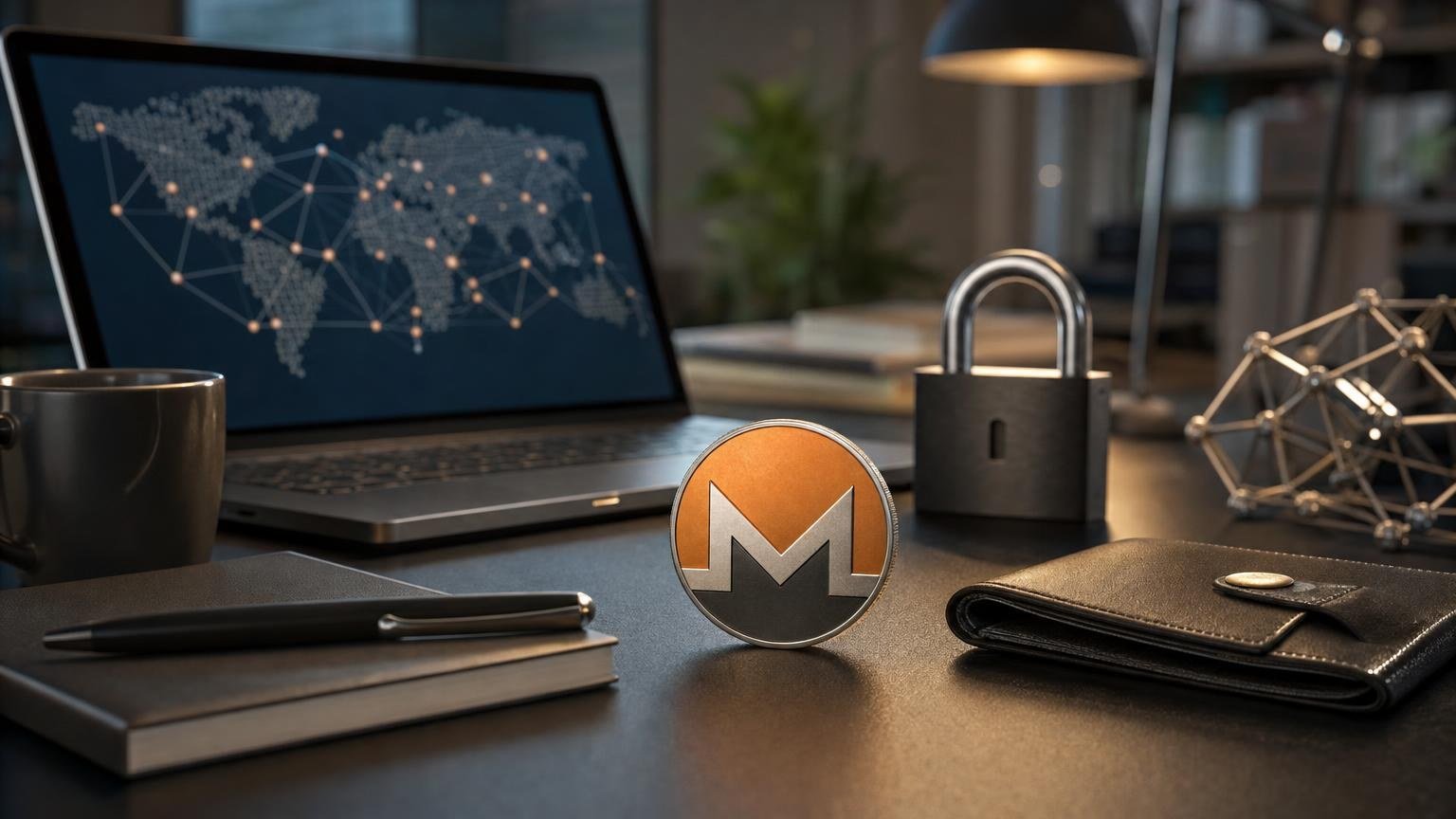
Monero protects transaction data recorded on its blockchain, but an XMR exchange also involves wallets, network connections, order records, and sometimes identity or compliance checks. A useful privacy assessment separates these layers instead of treating “private coin” as a promise that the entire operation leaves no observable information.
Claim-Checking Protocol for Monero Exchange Privacy
Monero hides transaction details on-chain, not every trace of an exchange
- Correct statement
- Monero is designed to conceal the transferred amount, the recipient’s published address, and which member of a signature group authorized a spend. RingCT hides amounts, stealth addresses create one-time destinations, and ring signatures obscure the real spent output among decoys. These protections apply to data recorded on the Monero blockchain. [1]
- Verdict
- Misleading: “Exchanging XMR is completely anonymous because Monero hides everything.”
- Why the simplification appears
- Descriptions of Monero often focus on blockchain observers. That narrower claim can be incorrectly extended to the exchange website, the user’s device, the network connection, and information supplied during an order.
- What goes wrong if you rely on it
- A user may disclose an email address, account details, an IP address, another cryptocurrency address, or compliance information while assuming that Monero’s cryptography removes those records. It does not. The official Monero FAQ explicitly warns that blockchain privacy cannot make information already given to another party disappear. [2]
- How to verify it
- Check the official explanations of RingCT, stealth addresses, and ring signatures. Then inspect the exchange process separately: note which information is requested before an order is created and which details appear in the order record.
- Practical takeaway
- Treat Monero privacy as protection for blockchain transaction data, not as automatic anonymity across the whole exchange process.
An exchange may link activity inside its own systems
- Correct statement
- A service that receives an XMR deposit can associate that payment with the order, account, session, or information used to initiate the exchange. If a user has an account, separate payouts may already be linked in the service’s database even when different Monero subaddresses are used. Official Monero documentation identifies this limitation directly. [3]
- Verdict
- Confirmed: exchange-side records can reveal relationships that are not visible to a general blockchain observer.
- Why the simplification appears
- “The blockchain does not publicly show the recipient” is sometimes understood as “the recipient cannot know who paid.” Those are different situations. The receiving service needs enough information to recognize the deposit and match it to the correct order.
- What goes wrong if you rely on it
- Repeated exchanges may be grouped through account records, order identifiers, browser data, network information, or the addresses of assets on the other side of the trade. Changing only the Monero receiving address does not remove those links.
- How to verify it
- Read the provider’s current privacy notice, order flow, and verification terms. During an exchange, observe which deposit address or payment identifier is assigned and what information remains visible in the order interface.
- Practical takeaway
- Evaluate what the exchange itself can know, not only what appears on a public block explorer. Verification requirements may depend on the exchange direction and the outcome of compliance checks, so current conditions need to be checked before creating an order.
Private transactions can still be confirmed and attributed by the parties involved
- Correct statement
- A Monero transaction has a transaction ID and can receive blockchain confirmations even though its destination and amount are not publicly readable in the same way as on a transparent blockchain. A sender can also generate a transaction proof that allows a specified payment to an address to be checked. The official wallet interface exposes methods for creating and validating these proofs. [4]
- Verdict
- Misleading: “Because Monero is private, an exchange cannot verify an XMR deposit.”
- Why the simplification appears
- Public inspection and recipient verification are often confused. A random observer lacks the wallet information needed to identify the recipient and amount, while the receiving wallet can scan for outputs addressed to it.
- What goes wrong if you rely on it
- A user may assume that a transaction ID is useless, fail to save order details, or disclose a transaction key unnecessarily when resolving a routine delay. Transaction proofs reveal information about a specific payment and should not be published casually.
- How to verify it
- Consult the Monero wallet RPC documentation for the payment-proof functions. In your wallet, compare the transaction ID and confirmation status with the details requested by the receiving service. Remember that a valid proof demonstrates a particular transfer but does not by itself guarantee that the funds remain spendable. [5]
- Practical takeaway
- Keep the transaction ID and order identifier available for support. Share additional proof data only when necessary, through the provider’s legitimate support channel, and after confirming exactly what the requested data reveals.
A fresh subaddress reduces some links but does not create a new identity
- Correct statement
- Monero documentation recommends subaddresses for receiving funds. Giving different payers different subaddresses can prevent a payer from easily recognizing the same published receiving address again. However, subaddresses derived from one wallet are not a universal separation mechanism, and an exchange account can still connect its own payouts or deposits through internal records. [3]
- Verdict
- Depends on conditions: “Using a new Monero address for every exchange makes the orders unlinkable.”
- Why the simplification appears
- Address reuse is a clear privacy concern on transparent blockchains, so generating a new address looks like a complete solution. With Monero, subaddresses improve a specific part of the privacy model but do not erase timing, account, device, or exchange-side information.
- What goes wrong if you rely on it
- A user may combine activity that needs stronger separation in one account or wallet, believing that different displayed addresses are independent identities. Consolidating outputs can also expose relationships in some circumstances to parties that already possess relevant contextual information.
- How to verify it
- Review the official subaddress documentation, especially its caveats about service accounts, active attacks, and combining funds. Check whether your wallet labels each subaddress clearly enough to avoid sending from or receiving to the wrong context. [3]
- Practical takeaway
- Use a fresh subaddress when appropriate, but choose separate wallets or operational profiles when genuine separation is required. A new subaddress alone is not evidence that two exchange orders cannot be connected.
Wallet connection choices affect privacy outside the blockchain
- Correct statement
- Connecting a wallet to an untrusted remote node can reveal network-level information or expose the wallet to misleading data. Monero’s official guidance warns that a malicious remote node may attempt to associate a clear-network IP address with transaction activity. Running a personal node avoids giving a third-party node the same view of wallet requests; a trusted node or privacy network can reduce other risks. [6]
- Verdict
- Confirmed: Monero’s on-chain protections do not automatically hide wallet-to-node network metadata.
- Why the simplification appears
- The blockchain protocol and the method used to reach the peer-to-peer network are separate technical layers, but wallet interfaces can make them feel like one system.
- What goes wrong if you rely on it
- A user may route sensitive wallet activity through an unknown node while assuming that ring signatures also conceal the originating network connection. A hostile node cannot take funds merely because a wallet connects to it, but it can create privacy and reliability concerns. [7]
- How to verify it
- Open the wallet’s node settings and identify whether it uses a local node, a chosen trusted node, or an automatically selected remote node. Compare the configuration with the official remote-node guidance, and keep wallet software current because releases may contain privacy and remote-node hardening fixes. [6]
- Practical takeaway
- For stronger network privacy, understand who operates the node your wallet uses. Running your own node provides more control, while an unknown public node requires a higher level of trust than its convenience may suggest.
A view key offers selective visibility, but it is not harmless metadata
- Correct statement
- A private view key allows another party to detect incoming transactions associated with a Monero wallet. It does not grant spending authority, but sharing it can expose a broad history of received payments rather than one isolated transfer. Official documentation also warns that outgoing activity and balances cannot always be reconstructed reliably from a view key alone. [8]
- Verdict
- Misleading: “Giving support a view key is the normal way to prove one exchange payment.”
- Why the simplification appears
- The term “view” sounds read-only and therefore low-risk. Read-only access can still reveal sensitive financial relationships, especially when the same wallet has received multiple payments.
- What goes wrong if you rely on it
- Disclosing the wallet-wide private view key may reveal more incoming activity than the recipient needs to resolve a single deposit. If the disclosure cannot be reversed, later payments to the same wallet may remain visible to the holder of that key.
- How to verify it
- Compare the official definitions of a private view key and a transaction proof. If support requests cryptographic information, ask whether a proof limited to the disputed transaction is sufficient. Never confuse a private view key with a private spend key or wallet seed.
- Practical takeaway
- Use the narrowest disclosure that solves the problem. Do not send a seed or private spend key to anyone, and avoid sharing a private view key when a transaction-specific proof is enough.
Where the Honest Answer Depends on Context
No single label such as “anonymous” or “traceable” accurately describes every XMR exchange. The result changes with the observer and the information available to that observer.
- A public blockchain observer generally sees a Monero transaction without openly readable sender, recipient, or transfer amount. The observer may still use timing and other contextual clues. Monero-funded research has documented that timing analysis can weaken the uncertainty provided by ring-signature decoys under stronger threat models, which is why protocol privacy should not be described as mathematically perfect anonymity. [9]
- The receiving exchange can recognize its deposit and associate it with an order. What else it knows depends on the order design, account model, compliance process, logs, and information provided by the customer.
- The sender knows the destination supplied by the service and may retain wallet records or transaction-proof data.
- A wallet node operator may observe connection metadata, depending on the wallet configuration and network route. The operator does not automatically receive the wallet’s private keys. [7]
- A party holding a view key or payment proof receives deliberately disclosed visibility. The scope differs: a transaction proof concerns a specified payment, while a private view key can expose incoming activity across the wallet. [8]
Context also includes the asset on the other side of the exchange. Moving from XMR to a cryptocurrency with a transparent ledger can create a publicly visible destination and later transaction trail on that network. Monero cannot extend its blockchain protections to another asset’s ledger.
Legal and compliance treatment varies by country, provider, transaction direction, and risk assessment. A privacy-preserving blockchain does not exempt an exchange or its users from applicable rules. Current verification requirements should be reviewed before an order is created rather than inferred from an earlier transaction.
Safety Checks Not Solved by Monero Privacy
- Confirm the asset, network, and address. XMR must be sent using the destination and instructions assigned to the order. Do not assume that a similarly named asset, wrapped token, or unsupported network is interchangeable. Cryptocurrency transfers are generally irreversible once accepted by the relevant network.
- Check current direction availability. Support for XMR does not mean that every possible XMR pair, network, or exchange direction is available. Verify the exact route before sending funds.
- Compare the complete address. Clipboard malware can replace a copied destination. Check the beginning, middle, and end of the address against the order page or wallet confirmation screen rather than relying only on the first few characters.
- Use a small test when the consequences justify it. A test transfer can reveal an address or workflow mistake, but it may create another fee and does not replace checking minimums, deposit rules, or whether multiple payments to one order are accepted.
- Protect the seed and spend key. Neither exchange support nor a payment recipient needs the wallet seed or private spend key. Anyone obtaining them may gain control of the funds.
- Watch for phishing. Reach the service through a verified bookmark or known entry point, inspect the domain carefully, and be suspicious of unsolicited support messages. Privacy features cannot protect funds sent to an attacker’s address.
- Allow for price movement. XMR and the asset received in exchange can change in value while an operation is being prepared or processed. Blockchain privacy does not remove volatility or guarantee a particular economic result.
- Keep non-secret records. Save the order identifier, transaction ID, destination shown by the service, and relevant timestamps. Store sensitive wallet keys separately and do not place them in screenshots or routine support messages.
A Practical Next Step Before Exchanging XMR
Start with a narrow question: what must remain private, and from whom? Then check the exact exchange direction, required wallet network, address format, current verification conditions, and what order data the provider retains or requests. The service supports XMR alongside several other crypto assets, but availability of a particular pair or direction should be confirmed for each operation.
Before transferring funds, check the current XMR exchange conditions and compare them with your privacy needs. If the process requires information you do not want to disclose, or if the wallet is connected through an untrusted node, pause before creating or funding the order. Monero can substantially reduce public blockchain exposure, but safe exchange privacy still depends on the surrounding systems and the choices made at each step.